
The storm has finally passed, and the eerie silence that follows a heavy downpour is broken only by the sound of water dripping from your eaves. I know that feeling of standing on your porch, looking at the ice pellets melting in your flowerbeds, and wondering if your home just took a beating.
You’re likely squinting at your roofline, trying to see if anything looks “off.” It’s a stressful position to be in, especially when you aren’t sure how to tell if your roof has hail damage without climbing a ladder you might not even own.
I want to walk you through this process person-to-person. From my years in the field, I can tell you that what you do in the next forty-eight hours matters. Let’s get you some clarity so you can stop worrying and start taking the right steps to protect your home.
Simple Checks to Tell If Your Roof Has Hail Damage
If your home features traditional three-tab shingles, the signs are usually quite distinct because the material is thinner and flatter. When I’m walking a property, I start by looking at the “valleys” and the lower edges. You are looking for physical indentations that have disrupted the uniform look of the roof.
| Inspection Area | What You Are Looking For |
| Gutter Apron | Dings or small dents in the metal flashing near the shingles |
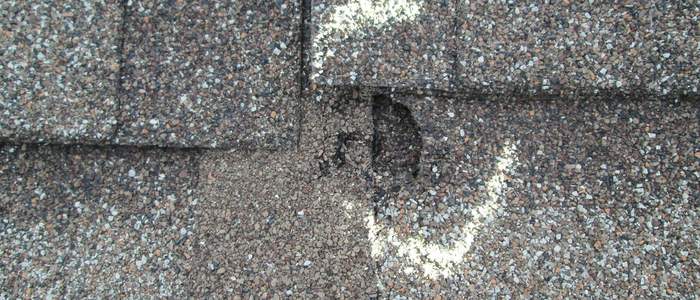
| Shingle Surface | Dark, circular spots where granules have been knocked away by hail impact |
| Downspout Ends | Large piles of loose granules washed down from the roof after a hailstorm |
A quick glance at your downspouts is often the best “first clue” when determining how to tell if your roof has hail damage. If you see a mound of mineral “sand” there, your shingles have definitely lost their protective layer and need a closer look.
Easy Ways to Spot Hail Hits on Your Roof
Laminated shingles are thicker, which makes the damage a bit more deceptive. You won’t always see a clean hole; instead, you’re looking for “bruises.” Imagine pressing your thumb hard into a piece of fruit that’s what a hail hit looks like on these shingles.
When you are wondering how to tell if your roof has hail damage, look for areas that appear slightly darker or “shiny.” This is the underlying asphalt mat peeking through.
If you can safely reach a section, press on a dark spot. If it feels soft or spongy compared to the rest of the shingle, the internal reinforcement is broken. I’ve seen these bruises lead to leaks months later because the sun bakes the exposed bitumen until it cracks wide open.
Quick Tests to Identify Roof Hail Damage
These shingles have a lot of texture, which can hide damage in the shadows. To accurately tell if your roof has hail damage, I recommend these specific checks:
- Check the High Points: Look at the “ridges” or the very top peaks of the roof; these areas take the most direct hail hits.
- The Shadow Test: Look at the roof during the “golden hour” (sunrise or sunset). Long shadows often reveal small pits that are invisible at noon.
- Feel the Texture: Run a hand over a suspected area; a hail strike will feel like a permanent dip in the material.
- Examine the Flashing: Look at the metal around your chimney. If the metal is dented, the shingles nearby almost certainly took hail damage too.
Hands-On Tips for Detecting Roof Hail Damage
Synthetic materials, like those made from rubber or plastic polymers, react differently than asphalt. They don’t have granules to lose, so you have to look for cracks or “spalling.” If you’re checking these, look for any white, stressed marks on the surface similar to what happens when you bend a piece of dark plastic.
I also check for “stars,” which are tiny fractures radiating out from a central impact point. Even though these materials are built to be tough, a large hailstone can compromise the UV coating. If you notice any shingle deformation or areas where the tiles are no longer sitting flat against each other, the impact likely warped the internal structure. It’s a subtle sign, but an important one when determining how to tell if your roof has hail damage on synthetic systems.
Inspect for Clear Roof Hail Damage Clues
Wood shakes are a different beast. When I inspect a cedar roof, I’m looking for splits and impact marks caused by hail. A hailstone hitting a dry wood shake will often cause a vertical crack. You can tell it’s fresh damage if the wood inside the crack is a bright, “new” tan color.
If the crack is weathered and gray, it was already there. Also, look for dents with sharp edges. These “scars” break the wood fibers, allowing water to soak into the shake rather than shedding off. If you see several fresh, light-colored splits across your roof, it’s a clear sign of hail damage that warrants a professional evaluation.
Foolproof Steps to Confirm Hail Damage on a Roof
Metal is durable, but it’s a “tattletale” when it comes to hail. It shows every hit, even if the damage is only cosmetic. Here is how I break down the inspection for metal hybrid roofing systems.
| Part of Roof | Evidence of Impact |
| Ridge Caps | Obvious “pockmarks” or dings on the very top metal trim |
| Valleys | Larger dents where the metal is reinforced and clearly shows hail strikes |
| Vents | Soft aluminum vents often look like they’ve been hit by a hammer after hail |
While a dent might not cause an immediate leak, chipped paint or coatings on metal shingles can lead to rust. I always check these dings to ensure the protective finish is still intact after a hailstorm.
How to Tell If Your Roof Has Hail Damage Without Climbing
Eco-friendly shingles made from recycled content are surprisingly resilient, but they aren’t bulletproof. You can often spot hail damage from the ground using a pair of binoculars. I tell homeowners to look for “dimples” in the reflection.
Because these shingles often have a slight sheen, a hail hit will distort the way light bounces off the surface. Look for any edges that appear “frayed” or lifted.
High winds often accompany hail, so if you see eco-tiles that are no longer aligned, the hail impact may have loosened the fasteners. Learning how to tell if your roof has hail damage on these specialized materials often comes down to noticing small breaks in the roof’s uniform texture.
How to Verify Hail Damage on Impact-Resistant Shingles
Even “hail-proof” shingles have their limits. If you have Class 4 shingles, don’t assume you’re in the clear after a major storm. Check for these signs of hail damage:
- Hidden Fractures: The surface may look fine, but the fiberglass mat underneath can be shattered by hail.
- Adhesion Failure: Check if the shingles feel “loose” or can be easily lifted; hail impact and vibration can break the sealant.
- Circular Bruising: Look for faint, ring-shaped discolorations where hail compressed the asphalt.
- Gutter Debris: Even impact-resistant shingles can lose granules during a severe hailstorm.
If the storm produced stones larger than two inches, even the best shingles need a manual “hand-tab” test by a professional to fully determine hail damage not just an inspection of areas that stay damp, but the entire roof system.
FAQ
How to tell if you have hail damage on shingles?
Hail damage on shingles often appears as small areas where granules have been knocked loose, soft impact marks on the shingle surface, or, in severe cases, punctures. Discoloration on otherwise consistent shingle areas or visible indentations are common indicators of hail impact. Over time, shingles affected by hail may begin to curl or develop cracks due to weakened material.
Should I get a professional roof inspection even if I don’t see hail damage?
A professional roof inspection is strongly recommended even when no obvious hail damage is visible. Hail and high winds can create hidden issues such as shingle bruising, loss of protective granules, or weakened sealant that are not easy to spot from the ground. If left unaddressed, this unseen damage can lead to leaks, mold growth, and early roof failure, potentially resulting in the need for a complete roof replacement later on.
How can you tell if your roof has been damaged by hail?
- Damage appears scattered with no consistent or recognizable pattern.
- Impact marks show dark or black discoloration.
- Granule loss is present, in some areas exposing the underlying roof felt.
- Sections of asphalt or matting have a smooth, glossy appearance.
- Impacted areas feel soft when pressed, similar to a bruise on an apple.
How does hail damage show on a flat roof?
Hail damage on a flat roof often appears as small dents, impact marks, or soft spots rather than obvious holes. Common signs include cracks or splits in the membrane, granule loss on modified bitumen roofs, punctures in thinner or aged materials, and damage around seams, flashing, and roof penetrations. In some cases, the damage is not immediately visible but later leads to leaks or moisture intrusion, making a professional inspection advisable after significant hailstorms.
Conclusion
Performing these checks isn’t about becoming a roofing expert overnight; it’s about knowing when to call one. If you’ve spotted even a few of these signs, you need a professional to document the extent of the harm. That’s where I come in. We provide detailed inspections that go far beyond a quick glance.
We use high-resolution photos and expert evaluation to distinguish between old wear-and-tear and fresh storm damage. Our goal is to give you peace of mind by providing an honest, clear assessment of your roof’s health. We help you document everything accurately so you have a solid record for your own home maintenance files.
Catching these issues early prevents expensive interior leaks and structural rot down the road. Now that you know what to look for, have you taken a walk around your yard to check those downspouts yet?